This is not Levi
Hebrews 7:1–28 · A Priest Forever
Beginning June 28, 2026
Draw Near
Hebrews 8-10 · The Worth of Once and For All
Beginning August 2, 2026
View Current Series →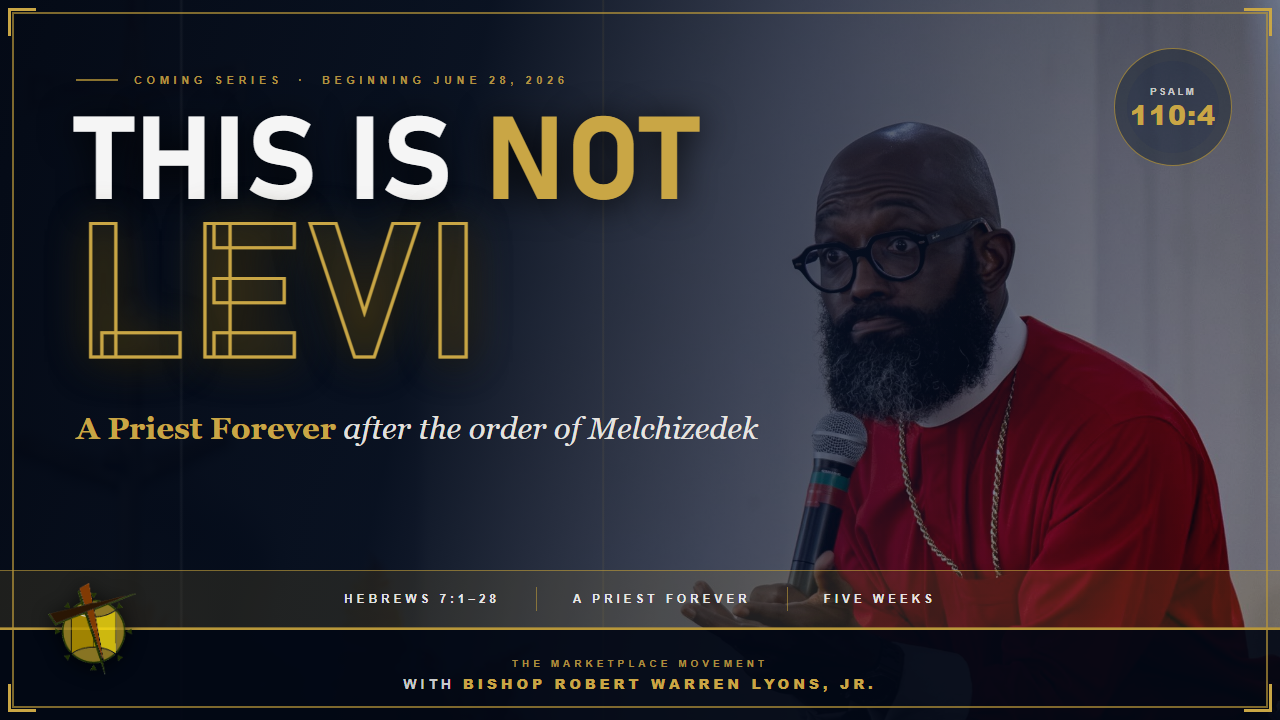
What Is This Series About?
The "Better Things" series closed at the threshold. Chapter 6 ended with the forerunner already inside the veil, declared a high priest forever after the order of Melchizedek. It left one question unanswered: who is this Melchizedek, and what does it mean that Jesus holds his order of priesthood rather than the one Israel knew?
Hebrews 7 answers that question in full. Bishop Robert W. Lyons, Jr. walks through Hebrews 7:1–28, the chapter that dismantles the entire Levitical priestly system not to dishonor it but to show what it was always pointing toward. The Levitical priesthood was never designed to last. It was designed to forerun. And the priest who came after it, before it actually, by the order of Melchizedek, holds His office not by genealogy and not by law but by the power of an indestructible life.
Five weeks. Hebrews 7:1 through 7:28. The series that answers the question Better Things could not close.
Five Weeks in Hebrews 7:1–28
Sunday Teaching
A figure appears in Genesis 14 without introduction: no genealogy, no birth record, no death notice. He receives a tithe from Abraham, blesses him, and disappears. His obscurity is not an accident. Melchizedek is not strange because he is legendary; he is strange because the text treats him as if the categories we use to measure priests do not apply to him. The question that opens the message: what do you do with a priest who exists outside every system you built to manage access to God?
The chapter never allows Melchizedek to remain a curiosity. He is a type, and types exist to be filled.
Wednesday Depth-Dive
Genesis 14:17–20 in full. The name meanings: Melchizedek is king of righteousness, melek plus tsedeq, and Salem is king of peace, shalom. His two titles are king of righteousness and king of peace, and Hebrews 7:2 names both deliberately. The bread and wine he brings to Abraham. Why does the father of the covenant people give a tenth to a Gentile king-priest he did not summon? Psalm 110:4 in its original Davidic context: David prophesying a coming king-priest of a completely different order. The typological logic: Melchizedek is a sign pointing forward, not the thing itself.
Your Work This Week
Journal Prompt
The categories we build to manage access to God can become the very things that keep us from recognizing when He shows up in a form we did not expect. Write about a time when something important entered your life without introduction or explanation. You did not ask for it, you did not expect it, and yet it was exactly what was needed.
Deeper Reading
- Genesis 14:17–20 The original encounter between Abraham and Melchizedek. Read what actually happened: the tithe given, the blessing spoken, the bread and wine brought. Nothing is explained. Sit with what the silence is doing.
- Psalm 110:1–4 The Davidic prophecy where the Melchizedek priesthood is named and promised. A king speaking to David's Lord about a priest of a different order.
- Hebrews 5:5–10 Where Melchizedek is first introduced in the letter. The author planted this seed and then paused. Chapter 7 is where it opens.
Reflection Questions
- Why do you think the writer of Hebrews gives Melchizedek this much attention? What is at stake if Jesus is simply a better Levitical priest rather than a priest of a completely different order?
- The text says Melchizedek met Abraham returning from battle, at his strongest moment. Why does this encounter happen there, and not at a moment of weakness or need?
- The bread and wine Melchizedek brings are given without demand. What does a gift given at strength rather than at need tell you about the nature of the priesthood being described?
- The deliberate silences of the text are significant. What do you normally look for when determining whether someone has authority? What happens when those normal markers are absent?
Sunday Teaching
Verse 11 makes a startling argument: if the Levitical priesthood had been sufficient, why would God promise in Psalm 110 a priest of a completely different order? The promise itself is the indictment. Every institution that cannot complete what it was designed to do is either holding the place for something better or it has become an obstacle. The word perfection here, teleiosis, means something brought to its intended completion. The Levitical system was not a failure; it was a forerunner. But forerunners step aside.
The genealogical impossibility of verse 14 is not a deficiency in Jesus; it is a signal that the whole category is being replaced.
Wednesday Depth-Dive
Leviticus 16, the Day of Atonement, as the high watermark of what the Levitical system could achieve. The preparation, the two goats, the entry into the Holy of Holies, the blood on the mercy seat, the scapegoat. The most important day of the Jewish calendar, and it had to be repeated every year. The repetition is the indictment. The system was designed to point forward. But forerunners that refuse to step aside become obstacles. Moses spoke nothing of priests from Judah. That is not a deficiency. It is a signal that the whole category is being replaced.
Your Work This Week
Journal Prompt
What system in your own life have you been maintaining past its usefulness, not because it is working but because you do not know what comes next? What in your life needs to be recognized as a forerunner rather than a destination?
Deeper Reading
- Leviticus 16:1–22 The Day of Atonement in full. Read what the system required at its highest point, and ask yourself why it had to happen again the following year.
- Hebrews 10:1–4 The impossibility of the blood of bulls and goats taking away sin. The law is a shadow, not the reality.
- Galatians 3:24–25 The law as a tutor leading to Christ. It was always meant to bring us somewhere, not to be the destination.
Reflection Questions
- What promise or prophecy in your own spiritual life is God using to show you that you need something better than what you currently have?
- What is the practical problem with a priesthood where access to office is determined by birth rather than by the kind of life you hold?
- In what areas of your life have you been waiting for institutional validation before you accept what God has already confirmed?
- You cannot get a new kind of priest through the old system. What old system are you expecting to produce a new kind of result?
Sunday Teaching
This message is built around the phrase zoe akatalutos, the indestructible life. The contrast is between a law of physical requirement and the power of a life that cannot be broken. Every Levitical priest's tenure ended, and the end was not just biological, it was theological. Death created gaps in priestly ministry. A gap between one priest's death and the next one's readiness was exposure: who speaks for me right now?
Then verse 19 plants the flag that the whole Better Things series was building toward: a better hope, through which we draw near to God. We are drawing near through a person who has conquered the only thing that ever stopped a priest from serving.
Wednesday Depth-Dive
Word study on zoe akatalutos, indestructible life. The contrast between entole sarkines, a law of physical requirement, and the power of an indestructible life. The phrase proserchomai, draw near, in verse 19 is sanctuary language, the language of approach. What does drawing near mean now that the veil has been torn? Cross-reference Hebrews 4:16 and Hebrews 10:22. The path to God has changed because the priest who holds it cannot die.
Your Work This Week
Journal Prompt
Every priest the old covenant had could be interrupted. Death. Sin. Age. Something always eventually broke the continuity. Write about a time when someone who was covering you spiritually became unavailable. What filled that gap?
Deeper Reading
- Hebrews 4:14–16 Draw near with confidence to the throne of grace. We approach because we already have a great high priest who has passed through the heavens.
- Romans 8:1–4 The law of the Spirit of life in Christ Jesus has set you free from the law of sin and death.
- Hebrews 10:19–22 The new and living way opened through the veil by His flesh. The access is open. The question is whether you will use it.
Reflection Questions
- What qualifies the people you give spiritual authority to in your own life: position, longevity, credential, or the actual quality of the life they hold?
- What has been your primary means of drawing near? Is it a practice, a system, or a person?
- What does it mean for your daily confidence to know that the life of your High Priest cannot be broken by anything that has ever threatened yours?
- Where in your life have you placed hope in something that could still fail?
Sunday Teaching
The distinction that opens this message: the difference between a position held by appointment and a position secured by oath. The Levitical priests were installed by the requirements of the law. Jesus was installed by the direct oath of God the Father, citing Psalm 110:4: You are a priest forever. When God swears, He is not adding credibility to something uncertain; He is making it unalterable.
The conclusion in verse 22 is that this makes Jesus the guarantee, the surety, of a better covenant. Guarantee is a legal and commercial term. What does it mean that the mediation of the new covenant is not a policy or a protocol but a person, and that person is sworn in by God Himself?
Wednesday Depth-Dive
Return to Hebrews 6:13–18 on divine oath-taking. God swears by Himself because there is nothing greater. Then the word engyos, guarantor or surety, from verse 22. A surety puts himself on the line for another's obligation. If the debtor cannot pay, the surety pays. Jesus as the surety of the new covenant means He takes personal responsibility for the covenant being fulfilled, not just mediated but guaranteed. Bridge forward to Jeremiah 31:31–34, which Hebrews will quote in full in chapter 8.
Your Work This Week
Journal Prompt
There is a difference between a commitment and an oath. Write about the promises you have received from God that you carry as commitments rather than as oaths, unalterable and impossible to break.
Deeper Reading
- Numbers 23:19 God is not a man that He should lie. The character behind the oath is the source of its certainty.
- Hebrews 6:13–18 The background on God swearing by Himself. Revisit it now in light of chapter 7.
- 2 Corinthians 1:20 All the promises of God are yes in Christ Jesus. Christ is the yes to every promise God has ever made.
Reflection Questions
- What is the practical difference between an office held by institutional requirement and an office secured by divine oath?
- What does it do to your understanding of salvation to know that the guarantee is personal, not institutional?
- The oath preceded the work. What does that sequence tell you about how God establishes what He intends to keep?
- What would a better covenant actually need to provide that the old one could not?
Sunday Teaching
Open with the sheer number: there were many priests. Each one served. Each one died. Each one left a gap. Each gap required a replacement. And the gap itself, the space between one priest's death and the next one's full readiness, was exposure. The question every worshiper eventually faced: who speaks for me right now?
Verse 25 answers that question with the finality the whole chapter has been building toward: He always lives to make intercession for them. This office has no succession, and the reason is ontological, not institutional. He does not vacate the office because He cannot die. He does not delegate the intercession because He is always present. He does not need a replacement for the sacrifice because He offered one that required no repetition.
Wednesday Depth-Dive
Intercession and what it actually looks like in the ministry of Jesus. Romans 8:34 alongside Hebrews 7:25: Christ at the right hand of God, interceding. The sinlessness of Jesus: holy, innocent, undefiled, separated from sinners, exalted above the heavens. The Aaronic high priest on Yom Kippur had to offer for himself before he could offer for the people. Jesus needs no such offering. Once for all, hapax, the finality of one sacrifice that never needs to be repeated.
Your Work This Week
Journal Prompt
Every human institution you have ever trusted has dealt with the problem of succession. Write about one of those moments in your own spiritual life, a succession that changed something for you. Now sit with this: there is one office in the universe where that question has never been asked and never will be.
Deeper Reading
- Romans 8:31–34 Who will bring a charge? Who will condemn? Christ who died is at the right hand of God, interceding.
- John 17:6–26 The High Priestly prayer of Jesus in the upper room. This is what His intercession sounds like.
- 1 John 2:1–2 We have an Advocate with the Father, Jesus Christ the righteous. You have legal representation before God.
Reflection Questions
- Where in your spiritual life have you been living with a gap that Jesus' permanent priesthood actually fills?
- What situation in your life right now needs you to hear always rather than sometimes or when you deserve it?
- What does it mean to you that the one interceding for you has no sin of His own that compromises His standing?
- What is the single thing from this series you will carry differently from this point forward?
Small Group Resources
Small group resources are being prepared for this series. If you are not part of a small group, please check our Discipleship Groups page on this site.